Water Treatment Plant in Dholera SIR

Key Highlights
The Dholera Water Treatment Plant is a key part of the water infrastructure developed for Dholera Special Investment Region (DSIR). The plant has a 50 MLD capacity, which means it is designed to treat up to 50 million litres of raw water per day.
The water system supports Dholera's industrial, residential, commercial and institutional development. In 2026, Dholera is also expanding its wider water-management infrastructure through projects such as a 20 MLD Common Effluent Treatment Plant (CETP) and a proposed 50 MLD seawater desalination plant.
What Is the 50 MLD Water Treatment Plant in Dholera?
The 50 MLD Water Treatment Plant in Dholera treats raw water and prepares it for potable-water supply.
It works as part of a larger Dholera water supply system that includes pumping stations, transmission pipelines, reservoirs and distribution networks.
NICDC project documents describe a raw-water transmission system from the Pipli Pumping Station, linked with the Pariyej Reservoir, to the Water Treatment Plant in Dholera SIR.
The existing 50 MLD capacity supports the current development stage, while government planning documents also show higher long-term water-treatment capacities as Dholera expands.
How Does the Water Treatment Plant Work in Dholera?
The Dholera Water Treatment Plant follows a step-by-step process to convert raw water into treated water:
Raw Water Intake → Coagulation & Flocculation → Sedimentation → Filtration → Disinfection → Storage → Distribution
First, raw water enters the plant. Small particles are grouped together and allowed to settle. The water then passes through filtration to remove remaining impurities. After this, it is disinfected, stored and supplied through the potable-water network.
A WTP is different from wastewater treatment. The WTP treats raw water for supply, while STPs and CETPs treat wastewater.
Why Is Water Infrastructure Important for Dholera Smart City?
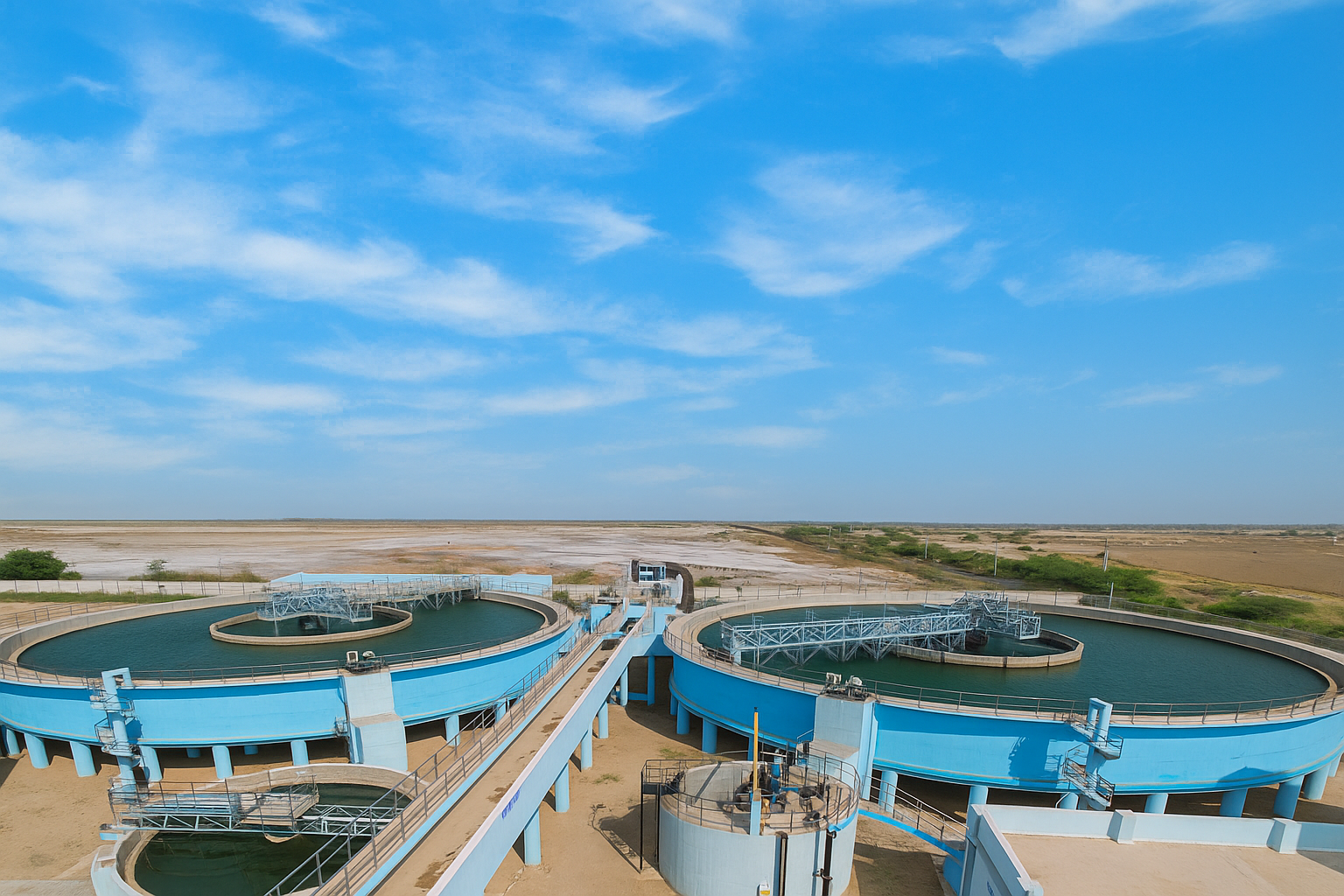
Reliable Dholera water infrastructure is essential because Dholera is being developed as a large industrial and urban centre.
Residential areas, offices, hospitals, commercial developments and industries all require a dependable water supply. Demand becomes even more important with major industrial investments such as the Tata Semiconductor Fab and other manufacturing facilities entering Dholera. The Tata semiconductor project alone is planned as a ₹91,000 crore facility with around 21,000 jobs.
Dholera also separates potable and recycled water systems, helping use treated water more efficiently for different requirements.
What Is the Difference Between WTP, STP and CETP in Dholera?
Dholera uses different treatment systems for different types of water:
- WTP: Treats raw water for potable-water supply. Dholera's current WTP capacity is 50 MLD.
- STP: Treats domestic sewage from residential, commercial and institutional areas. NICDC material lists a 10 MLD STP for the Activation Area.
- CETP: Treats industrial wastewater. The Activation Area planning includes 20 MLD CETP capacity.
- Recycled Water Network: Distributes treated wastewater for suitable non-potable uses.
Together, these systems form an important part of Dholera Smart City water management.
Conclusion
The Dholera Water Treatment Plant forms an important part of Dholera's planned utility infrastructure. Its 50 MLD treatment capacity, along with sewage treatment, industrial effluent treatment, recycled-water systems and the proposed desalination plant, supports Dholera's long-term industrial and urban development.
As Dholera grows, its water-management infrastructure will remain essential for industries, businesses and future residential communities.
FAQs
Q. What is the capacity of Dholera Water Treatment Plant?
The Dholera Water Treatment Plant has a capacity of 50 MLD, equal to 50 million litres of water per day.
Q. Is Dholera Water Treatment Plant operational in 2026?
Dholera has developed a 50 MLD WTP as part of its trunk water infrastructure. Other parts of the wider water network remain at different stages of development.
Q. Where does Dholera get its water from?
NICDC documents describe raw-water transmission from the Pipli Pumping Station, associated with Pariyej Reservoir, to the WTP in Dholera SIR.
Q. Does Dholera have a 24×7 water supply?
Dholera's infrastructure is planned for reliable managed water distribution. A blanket claim of 24×7 water supply across every location in Dholera should be avoided unless confirmed for that specific area.
Q. What is the difference between WTP, STP and CETP in Dholera?
A WTP treats raw water for potable supply, an STP treats domestic sewage, and a CETP treats industrial wastewater. Each has a separate role in Dholera's water-management system.


